The Gmail Exodus: Why European Professionals Are Abandoning Free Email
Your inbox contains your entire digital life -contracts, conversations, credentials. European professionals are discovering that 'free' email costs more than they realized. Here's what they're switching to and why.
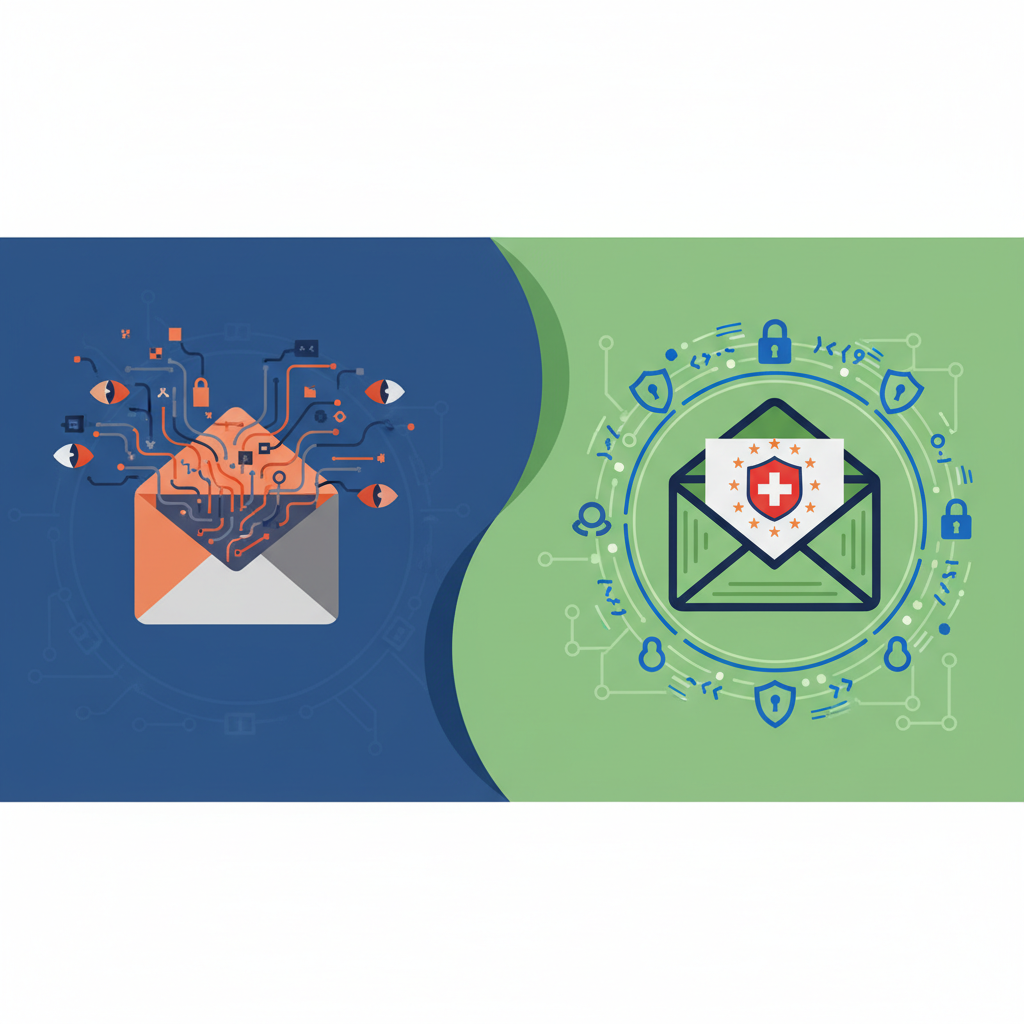
Zero-access encryption, Swiss jurisdiction, free tier available
Try ProtonMail →The email in your inbox right now -the one with the contract attachment, the salary negotiation, the medical appointment confirmation -where is it actually stored?
If you’re using Gmail, it’s on Google’s servers. Servers that Google’s AI reads to serve you ads. Servers that US law enforcement can access without your knowledge. Servers that have been the subject of repeated EU regulatory scrutiny.
The uncomfortable truth: Gmail is not a private communication tool. It’s an advertising platform that happens to deliver email. Your messages are the product -scanned, analyzed, and monetized.
For years, the convenience seemed worth it. Free email, massive storage, tight integration with everything else. But European professionals are increasingly asking: what’s the real cost of free?
What Google Knows About You
Your email inbox is an autobiography. Not just the messages you write, but the ones you receive:
The Data Profile
| What Gmail Captures | What Google Learns |
|---|---|
| Purchase receipts | Your spending habits |
| Travel confirmations | Your location patterns |
| Bank statements | Your financial status |
| Medical appointments | Your health concerns |
| Job applications | Your career trajectory |
| Personal conversations | Your relationships |
The average Gmail user has 17,000 emails in their inbox. That’s 17,000 data points about your life -every subscription, every conversation, every receipt -feeding Google’s advertising machine.
The Scanning Reality
Google’s official position has evolved over the years. They stopped scanning emails for ad targeting in 2017. But:
- AI still reads emails for Smart Reply and Smart Compose features
- Emails are still analyzed for spam filtering (legitimate) and “improving services” (vague)
- Third-party app permissions can grant extensive email access
- Google’s business model remains advertising -data is their core asset
The Legal Exposure
For European professionals, the legal dimension matters as much as the privacy dimension.
US Legal Framework
Under current US law:
| Law | What It Allows |
|---|---|
| CLOUD Act | US agencies can demand data from US companies regardless of where it’s stored |
| FISA 702 | Surveillance of non-US persons without individual warrants |
| National Security Letters | Secret demands for data with gag orders |
The Schrems II Problem
The European Court of Justice’s Schrems II ruling invalidated the EU-US Privacy Shield because US surveillance laws provide inadequate protection for EU citizens’ data.
The subsequent EU-US Data Privacy Framework has been adopted, but:
- Privacy advocates consider it insufficient
- It could face legal challenges similar to its predecessors
- The fundamental US legal framework hasn’t changed
Professional risk: If you’re a lawyer, doctor, accountant, or handle any confidential client information, using US email providers may conflict with your professional obligations. Several EU bar associations have issued guidance against using US cloud services for client communications.
The Microsoft Alternative Isn’t Better
“We use Outlook -it’s more professional.”
Outlook is owned by Microsoft, a US company with the same legal obligations:
- Subject to CLOUD Act
- Microsoft 365 compliance has been questioned by German DPAs
- Integration with Microsoft 365 creates the same data concentration risks
Moving from Gmail to Outlook changes your vendor, not your legal exposure.
The European Alternatives
The good news: European email has never been stronger. Swiss and German providers offer world-class services with genuine privacy.
 🇨🇭ProtonMail
Best for: Privacy-focused professionals, journalists, activists, anyone handling sensitive information
ProtonMail pioneered encrypted email for the masses. End-to-end encryption means even Proton can’t read your emails. Swiss jurisdiction provides strong legal protection.
| Strength | Details |
|---|---|
| Encryption | End-to-end by default between Proton users |
| Jurisdiction | Switzerland, outside EU/US legal reach |
| Zero-access | Proton cannot decrypt your emails |
| Open source | Audited, transparent code |
Price: Free (1GB), Plus from €4/month (15GB+)
The catch: Encryption works best between Proton users. Emails to Gmail users are encrypted in transit but not end-to-end unless you use password-protected messages.
Proton ecosystem: ProtonMail integrates with Proton Drive, Calendar, and VPN. If you’re leaving Google’s ecosystem, Proton offers a full alternative -all with Swiss privacy.
 🇩🇪Tuta
Best for: Privacy seekers who want full encryption including metadata, excellent value
Tuta (formerly Tutanota) goes further than most providers: they encrypt email subjects, not just content. German engineering, German privacy standards.
| Strength | Details |
|---|---|
| Full encryption | Subjects, content, and attachments |
| German jurisdiction | Strong EU privacy laws |
| Zero-knowledge calendar | Even calendar data is encrypted |
| Affordable | Best value in encrypted email |
Price: Free (1GB), Premium from €3/month (20GB)
The catch: No IMAP/POP support -you must use their apps. This ensures encryption but limits flexibility.
 🇩🇪Mailbox.org
Best for: Business users, those who need standard email protocols, Office integration
Mailbox.org is the pragmatic choice. Standard protocols (IMAP/SMTP), excellent calendar and contacts, optional encryption. German-run, privacy-focused, but without forcing you into a closed ecosystem.
| Strength | Details |
|---|---|
| Standards | Full IMAP/SMTP support |
| Office suite | Built-in document editing |
| Calendar/Contacts | Full CalDAV/CardDAV support |
| Custom domains | Easy business setup |
Price: From €1/month (Standard) to €9/month (Business)
The catch: Encryption is optional, not default. You get privacy through jurisdiction, not cryptography.
 🇨🇭Infomaniak Mail
Best for: Those wanting generous free storage, Swiss privacy, familiar interface
Infomaniak is a Swiss web services company offering email as part of a broader ecosystem. Their free tier is remarkably generous: 20GB storage with no ads.
| Strength | Details |
|---|---|
| Free tier | 20GB, no advertising |
| Swiss privacy | Strong data protection |
| Integrated suite | Works with kDrive, calendar |
| Familiar interface | Traditional webmail experience |
Price: Free (20GB), Premium services available
The catch: Less known internationally than ProtonMail. Support primarily in French/German.
The best EU email provider depends on your threat model. Need maximum encryption? ProtonMail or Tuta. Need standard protocols and business features? Mailbox.org. Want free storage with Swiss privacy? Infomaniak.
The Migration Reality
Switching email providers feels daunting. It’s more manageable than you think.
What Migration Actually Involves
| Task | Difficulty | Time |
|---|---|---|
| Import existing emails | Easy (automated) | Hours-days |
| Update important accounts | Medium | Ongoing |
| Inform contacts | Easy | Once |
| Set up forwarding | Easy | Minutes |
| Fully transition | Varies | Weeks-months |
The Parallel Running Strategy
Don’t go cold turkey. Run both accounts in parallel:
Week 1-2: Set up new EU email
- Create account with new provider
- Import your Gmail archive (most providers offer tools)
- Set up forwarding from Gmail to new account
Week 3-4: Start using new email
- Update important accounts (bank, government, healthcare)
- Use new email for all outgoing messages
- Let contacts know your new address
Month 2-3: Wind down Gmail
- Update remaining accounts as notifications arrive
- Monitor Gmail forwarding for stragglers
- Reduce Gmail checking frequency
Month 4+: Full transition
- Stop actively checking Gmail
- Keep forwarding active as safety net
- Eventually close Gmail (optional)
The forwarding trick: Set Gmail to forward all incoming mail to your new address. You’ll catch any accounts you forgot to update without actively checking Gmail.
The Account Update Challenge
The hardest part isn’t moving emails -it’s updating accounts. Here’s how to prioritize:
Update immediately:
- Banking and financial services
- Government and tax authorities
- Healthcare providers
- Primary social media accounts
Update soon:
- Shopping sites (as you make purchases)
- Subscriptions and services
- Professional contacts
Update when convenient:
- Newsletters and mailing lists
- Rarely-used accounts
The Cost Calculation
Free email isn’t free. You’re paying with data. Here’s what actual email costs look like:
Direct Cost Comparison (Individual)
| Provider | Annual Cost | Storage |
|---|---|---|
 🇺🇸Gmail 🇺🇸Gmail | €0 | 15GB (shared with Drive) |
| €0 | 15GB | |
| 🇨🇭ProtonMail Free | €0 | 1GB |
| 🇨🇭ProtonMail Plus | €48/year | 15GB |
| 🇩🇪Tuta Free | €0 | 1GB |
| 🇩🇪Tuta Premium | €36/year | 20GB |
| 🇩🇪Mailbox.org | €12/year | 2GB |
| 🇨🇭Infomaniak Mail Free | €0 | 20GB |
The Hidden Cost of Free
| Factor | 🇺🇸Gmail | EU Providers |
|---|---|---|
| Ad targeting | Yes | No |
| Data mining | Yes | No |
| US legal exposure | Yes | No |
| Professional risk | Higher | Lower |
| Peace of mind | Questionable | Higher |
€36-48 per year is less than €1/week -the price of half a coffee. That’s the cost of not being the product.
Business Email Calculation
For teams, the economics are even clearer:
| Provider | 10 users/year |
|---|---|
| Google Workspace | €600-1800 |
 🇺🇸Microsoft 365 🇺🇸Microsoft 365 | €600-1500 |
| 🇩🇪Mailbox.org | €120-1080 |
| 🇨🇭ProtonMail Business | €480-960 |
EU providers are often cheaper while providing better privacy.
When to Stay, When to Go
Here’s the honest assessment:
Stay with Gmail if:
- You don’t handle sensitive professional information
- Privacy concerns don’t outweigh convenience
- You’re deeply embedded in Google’s ecosystem with no desire to change
- Free storage is essential and 1GB isn’t enough
Switch to EU email if:
- You handle confidential client or patient information
- You’re a professional with duty-of-care obligations
- Privacy matters to you as a principle
- You want to own your email, not be owned by it
- You’re uncomfortable with US legal jurisdiction
Consider encryption-focused providers if:
- You’re a journalist, activist, or researcher
- You work with sensitive sources or information
- You want mathematical rather than legal privacy guarantees
- You’re in a profession where confidentiality is paramount
The Email Identity Question
Your email address is your digital identity. When you use @gmail.com:
- You’re advertising Google
- Your identity is tied to a US corporation
- Changing is harder the longer you wait
With a custom domain (@yourname.com or @yourbusiness.com), you can:
- Switch providers without changing addresses
- Project professionalism
- Own your identity
Future-proofing: Most EU email providers support custom domains. Set up your own domain now, point it at your EU provider, and you’ll never need to change your email address again -regardless of which provider you use.
What Happens After Switching
Users who’ve migrated consistently report:
Expectations vs. Reality
| Expected | Actual |
|---|---|
| Missing features | Minimal differences |
| Reliability issues | Equal or better |
| Spam problems | Similar or improved |
| Adjustment period | Brief (1-2 weeks) |
The Psychological Shift
There’s a mental shift that comes with leaving Gmail:
- You stop being the product
- Your inbox feels more private
- Fewer “personalized” suggestions means less surveillance
- Email becomes a tool again, not a data pipeline
The biggest surprise for most Gmail refugees: they don’t miss it. The features they thought they needed were often just conveniences they didn’t actually use.
The Future of Email Privacy
Three trends to watch:
1. Encryption Becoming Standard
What ProtonMail and Tuta pioneered is spreading. More providers are adding encryption options. The expectation of email privacy is growing.
2. AI Everywhere
Google, Microsoft, and others are racing to add AI to email. These AI features require reading your emails. EU providers are taking more cautious approaches, offering AI only with explicit consent and local processing.
3. Regulatory Pressure
EU regulators continue scrutinizing US cloud services. Future rulings could make Gmail/Outlook usage more complicated for European businesses. Moving early avoids forced rushed migrations later.
Making the Decision
Your email provider is more intimate than your bank. Banks hold your money. Email holds your thoughts, your relationships, your life.
The choice isn’t just about privacy -it’s about ownership. Do you want to rent your digital identity from an advertising company, or own it yourself?
European alternatives have matured. They’re reliable. They’re affordable. They’re often better than the “free” options once you account for what free actually costs.
The question isn’t whether you can switch -you can. The question is whether you’re ready to take back your inbox.
For a growing number of European professionals, the answer is clear.
Related reading:
- EU Email Comparison – Detailed feature comparison
- All Email Tools – Browse EU options
- The Slack Exodus – Team chat migration
- Why EU Software Matters – The bigger picture
This analysis represents the author’s research and opinion. Always evaluate email providers against your specific professional requirements and obligations.